
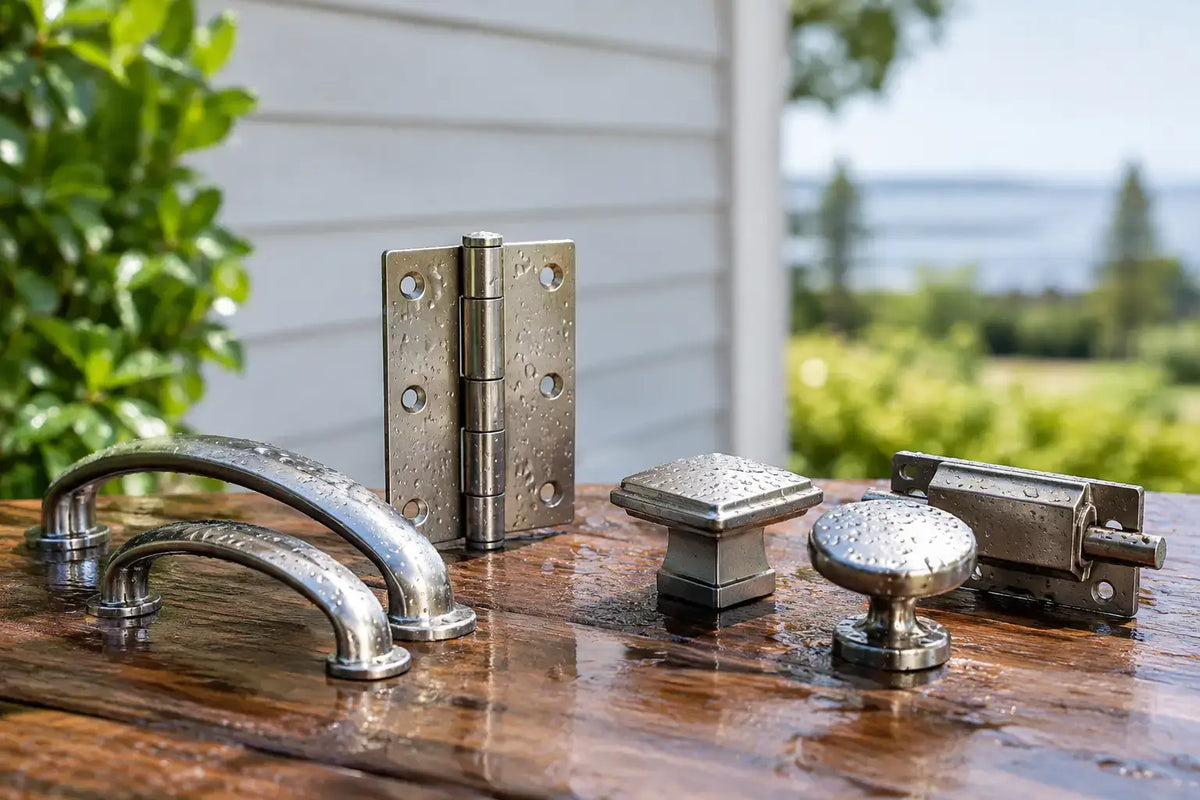
An outdoor kitchen can feature precision cabinetry, a premium grill, and a beautifully finished countertop, yet still feel ordinary if the doors sag, catches corrode, or drawers bind after one wet season. The best weatherproof cabinet hardware protects the daily experience of your kitchen: every pull, close, latch, and adjustment should feel composed and effortless, regardless of heat, rain, salt air, or winter temperature swings.
For design-conscious homeowners and hospitality buyers, hardware is not a finishing detail. It is a performance system. It determines whether outdoor cabinetry remains aligned, secure, and enjoyable to use over years of entertaining. Selecting it well requires more than choosing a metal that looks polished on day one.
What Defines the Best Weatherproof Cabinet Hardware?
Weatherproof hardware is built to resist the specific forces that cause outdoor cabinetry to fail: moisture intrusion, corrosion, ultraviolet exposure, airborne contaminants, temperature changes, and repeated use. The strongest options combine corrosion-resistant materials with a construction that avoids exposed weak points, trapped water, and incompatible metals.
Stainless steel is often the right starting point, but the grade matters. Type 304 stainless steel performs well in many covered patios and typical residential settings. For coastal homes, poolside kitchens, high-humidity climates, and commercial terraces, Type 316 stainless steel is the better specification. Its added molybdenum provides meaningfully stronger resistance to chlorides, which are present in salt air and can also come from pool chemicals.
A hardware label that simply says "stainless" is not enough. Ask what grade is used for hinges, fasteners, slide rails, and springs. A cabinet can have stainless handles while relying on plated steel screws or internal hinge components that become the first point of corrosion. Premium outdoor construction treats each component as part of one durable system.
Weatherproof does not mean maintenance-free or invulnerable. No material can ignore years of coastal exposure, neglected spills, or trapped moisture. It does mean the hardware has been chosen and engineered to handle normal outdoor conditions without compromising the kitchen's appearance or function.
The Outdoor Hardware That Deserves the Closest Attention
Hinges: Where Alignment Is Won or Lost
Cabinet hinges work harder outdoors than most buyers expect. They carry door weight, absorb constant opening and closing, and must retain their adjustment despite expansion and contraction in the cabinet structure. Choose fully corrosion-resistant hinges with concealed or protected mechanisms where possible. Multi-axis adjustment is equally valuable because it allows a professional to keep door reveals precise if a cabinet settles or a surface moves slightly over time.
Soft-close hinges can be an excellent luxury feature, but only when they are rated for exterior use. Indoors, soft-close mechanisms are protected from humidity and contaminants. Outside, their springs, dampers, and housings need the same level of corrosion resistance as the hinge body. A poorly specified soft-close hinge often announces itself with a door that begins to close unevenly or no longer cushions consistently.
For wide, heavy doors, do not rely on a standard hinge count. Additional hinges distribute load, reduce stress on mounting points, and preserve a clean, even door line. This matters especially for outdoor cabinets clad in metal, porcelain, stone, or other substantial architectural finishes.
Drawer Slides: The Difference You Feel Every Day
Full-extension drawer slides make an outdoor kitchen more functional because every utensil, accessory, and serving piece remains visible and accessible. Yet slide assemblies are also among the most exposed mechanical elements in a cabinet. Ball bearings, raceways, and release mechanisms need corrosion-resistant materials and reliable drainage.
Look for slides specified for exterior or high-moisture applications, with a load rating appropriate to the intended contents. A drawer for napkins has different demands from a deep drawer holding cookware, grill tools, and beverage supplies. Soft-close drawer slides add refinement, but their dampers should be protected from direct runoff and positioned inside a cabinet designed to limit water entry.
The most elegant drawer face cannot compensate for a slide that rattles, sticks, or develops orange staining around the runners. Smooth operation is one of the clearest signs that an outdoor kitchen has been engineered for real use rather than styled for a showroom.
Pulls, Handles, and Finger Pulls
Handles are touched more than any other cabinet component, so comfort and finish retention both matter. Solid stainless steel pulls are a reliable choice for contemporary outdoor kitchens, particularly in brushed finishes that disguise fingerprints and minor surface marks. Powder-coated aluminum can also perform beautifully when the coating is high quality and the underlying material is suitable for exterior use.
The trade-off is architectural simplicity versus cleaning access. Integrated finger pulls create a sleek, uninterrupted façade and suit minimalist kitchen designs. However, they should be shaped to shed water rather than collect it, and they need enough depth to operate comfortably with wet hands. Projecting handles offer a more natural grip, particularly on large doors and drawers, but create more edges to clean around.
Avoid decorative hardware with hollow cavities, peeling plated finishes, or intricate joints that retain moisture. Outdoor luxury is defined by restraint: fewer places for water and debris to hide, and more confidence every time the kitchen is used.
Latches, Locks, and Magnetic Catches
Outdoor cabinet doors need positive closure. Wind, uneven decks, and changing temperatures can turn a lightly held door into a persistent annoyance. Marine-grade latches or compression latches offer secure closure for exposed locations, while high-quality magnetic catches can be appropriate for sheltered kitchens with lighter doors.
For homes with children, vacation properties, or hospitality settings, locking cabinets add practical control over cleaning products, gas-related accessories, and valuable equipment. Select locks with weather-resistant cylinders and covers where exposure is high. The lock should feel integrated into the cabinet design, not added as an afterthought that interrupts the façade.
Hardware Must Match the Cabinet Construction
Even exceptional hardware can underperform when mounted into the wrong substrate. Outdoor cabinet bodies made from aluminum, stainless steel, marine-grade polymer, or other non-swelling materials provide a stable foundation for hinges and slides. Traditional interior-grade particleboard is a poor partner for exterior hardware because moisture can compromise the mounting area long before the hardware itself fails.
Fasteners are equally significant. Whenever possible, use stainless fasteners matched to the environment and to the cabinet material. Mixing dissimilar metals can create galvanic corrosion, particularly when moisture and salt are present. For example, an incompatible screw hidden behind a hinge may leave streaking, seize in place, or weaken a connection that appeared flawless at installation.
Thoughtful cabinet engineering also creates protection around the hardware. Overhangs, recessed doors, drip edges, drainage paths, and ventilated interior spaces reduce direct exposure. This is why pre-engineered luxury systems offer a meaningful advantage over piecemeal outdoor builds. At ELEEXA, the cabinet, hardware, finish, and appliance integration are considered as one coordinated outdoor environment rather than a collection of separate parts.
How to Choose Hardware for Your Climate
Start with your exposure level, not just your aesthetic preference. A covered backyard kitchen in a dry inland climate can accommodate more finish options than an open rooftop beside the ocean. The latter demands Type 316 stainless steel, protected slide mechanisms, positive latches, and a cabinet design that manages wind-driven rain.
Use this practical specification check before committing to an outdoor kitchen:
- Confirm the metal grade for hinges, slides, pulls, fasteners, and internal components.
- Ask whether soft-close mechanisms and drawer slides are rated for outdoor or high-humidity use.
- Check how doors and drawers are protected from direct rainfall, standing water, and ultraviolet exposure.
- Make sure hardware capacity matches the weight and width of each door or loaded drawer.
- Review whether replacement components can be adjusted or serviced without dismantling the kitchen.
Preserve the Finish With Simple Seasonal Care
Routine care is straightforward, but consistency pays off. Wipe hardware with fresh water and a soft cloth after heavy use, particularly near pools or in coastal areas. Use a mild, non-abrasive cleaner for grease and fingerprints, then dry the surface rather than allowing mineral-rich water to evaporate on it.
Avoid steel wool, chlorine-based cleaners, and harsh abrasive pads. They can damage protective finishes and leave particles that encourage rust staining even on stainless steel. Open doors and drawers periodically to clear leaves, dust, and debris from tracks, catches, and drainage areas.
Once or twice a year, inspect hinge screws, door alignment, drawer glide, and latch engagement. Small adjustments made early preserve the tailored, precision-built feel that distinguishes a premium outdoor kitchen.
The right hardware lets the kitchen disappear into the occasion: doors open without effort, drawers close with quiet confidence, and every surface stays worthy of the setting. That is the standard to expect when your outdoor space is designed not merely to withstand the elements, but to elevate life outside.

