A luxury outdoor kitchen has to look exceptional long after the first summer of entertaining. That is why the decision between marine grade cabinets versus teak is about more than visual preference. It affects how your kitchen handles rain, sun, salt air, grease, cleaning, movement, and the amount of attention it requires year after year.
Both materials can belong in a premium outdoor setting. The right choice depends on whether you want engineered consistency and minimal upkeep, or natural warmth with a more hands-on ownership experience. For most permanent outdoor kitchens, especially in exposed locations, material performance should lead the decision and style should refine it.
Marine Grade Cabinets Versus Teak: Know the Difference
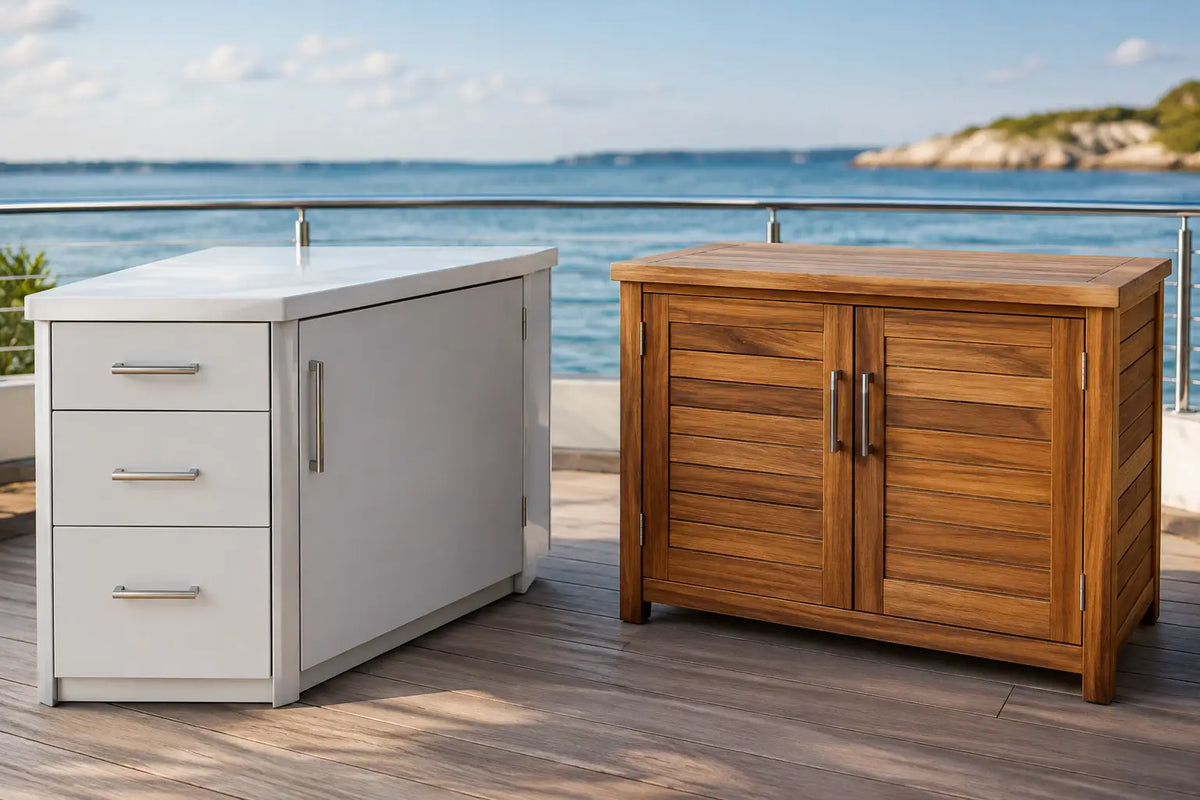
The phrase “marine grade” can describe several material systems, so buyers should look beyond the label. In outdoor cabinetry, it usually refers to cabinets built with corrosion-resistant metals, weather-stable panels, protective coatings, and hardware selected for demanding conditions. Aluminum cabinetry with a high-quality powder-coated finish is a common premium solution because it is lightweight, stable, and naturally resistant to corrosion.
Teak is a dense hardwood valued for its natural oils, tight grain, and rich golden-brown appearance. It has a long association with yachts, terraces, and resort furniture because it withstands moisture better than many other woods. However, teak is still a natural material. It expands, contracts, changes color, and develops a weathered surface over time.
That distinction matters. Marine-grade cabinetry is engineered to maintain its form and finish with limited intervention. Teak offers character and authenticity, but its appearance evolves in response to weather and care.
Weather Performance Is More Than Rain Resistance
Rain is only one pressure point in an outdoor kitchen. Cabinets also contend with ultraviolet exposure, standing moisture, temperature swings, airborne pollutants, grease, and salt in coastal regions. The best cabinet solution manages all of these forces at the same time.
A well-built marine-grade cabinet system is designed around predictable performance. Powder-coated aluminum does not absorb water, which helps prevent swelling, warping, and cracking. Quality finishes retain their color well, while corrosion-resistant hinges, drawer runners, fasteners, and adjustable feet protect the less visible parts of the kitchen. This is especially valuable when the kitchen sits on an open terrace, beside a pool, or near the coast.
Teak handles wet conditions admirably for wood, but it does not become maintenance-free simply because it is durable. Repeated wet-dry cycles can raise the grain. Intense sunlight will gradually turn untreated teak from warm brown to silver-gray. Neither result necessarily means the wood is failing, but owners who want teak to retain an even, refined appearance must be prepared to clean and treat it on a schedule.
In coastal environments, the gap can widen. Salt residue settles on every outdoor surface and should be rinsed away regularly. Teak can perform well near the ocean, but metal cabinetry with a properly specified marine-grade finish and hardware generally provides a more controlled, lower-risk ownership experience.
Maintenance Separates Convenience From Craft
For many homeowners, the real question is not which material can survive outdoors. It is how much time they are willing to dedicate to keeping it looking exactly as intended.
Marine-grade cabinets are usually the simpler choice. Routine care often means wiping the surfaces with mild soap and water, avoiding abrasive cleaners, and periodically checking drainage and hardware. A quality cabinet finish is meant to make entertaining easier, not create another seasonal restoration project.
Teak rewards care, but it asks for it. Gentle cleaning removes surface dirt and mildew. If you prefer the original honey-toned color, oiling or sealing may be needed, depending on the product and climate. If you prefer the silver-gray patina, the maintenance burden can be lighter, although cleaning remains necessary. Either route requires accepting that natural variation is part of the material’s appeal.
This is where lifestyle should decide the material. A homeowner furnishing a weekend retreat may enjoy the ritual of maintaining teak. A hospitality property, a busy family home, or a rental villa often benefits from cabinetry that presents beautifully with less staff time and fewer variables.
Design: Architectural Precision or Organic Warmth?
Teak has an immediate emotional advantage. Its grain, color, and tactile quality make an outdoor setting feel relaxed, established, and resort-inspired. It pairs particularly well with natural stone, textured plaster, travertine, and landscape-heavy gardens. Used sparingly, teak can soften a contemporary composition without making it feel rustic.
Marine-grade cabinetry delivers a different kind of luxury. It creates clean reveals, consistent panel lines, precise proportions, and an architectural finish that can coordinate with window frames, outdoor furniture, grills, and interior kitchen details. Color choices such as deep charcoal, soft gray, warm taupe, or matte black can make the outdoor kitchen feel designed into the property rather than added afterward.
For a modern villa, rooftop terrace, or hospitality terrace, that level of visual order is often the stronger choice. It also allows larger kitchen runs to maintain a uniform appearance, even when they combine refrigeration, storage, sinks, burners, and built-in grills.
The most sophisticated projects do not always treat this as an either-or decision. Marine-grade cabinets can form the high-performance structure, while teak appears as a serving shelf, slatted accent, bar detail, or nearby dining furniture. This approach brings natural warmth to the space without making wood responsible for every cabinet door and drawer.
Compare the Long-Term Cost, Not Just the Purchase Price
A teak outdoor kitchen may appear attractive at first glance because wood has an unmistakable premium look. Yet the initial price is only part of the equation. Long-term cost includes cleaning products, protective treatments, periodic refinishing, potential component replacement, and labor if the work is outsourced.
Marine-grade cabinetry can command a premium upfront investment when it includes engineered aluminum construction, refined powder coating, durable hardware, and pre-assembled modules. Its value becomes clearer over time: fewer maintenance demands, stable alignment, straightforward cleaning, and a finish that is easier to keep consistent across a complete kitchen installation.
| Consideration | Marine-grade cabinets | Teak |
|---|---|---|
| Surface behavior | Non-porous, engineered, consistent | Natural grain, porous, evolving |
| Sun exposure | Strong color retention with quality finish | Will fade to gray without treatment |
| Routine care | Simple washing and inspections | Cleaning plus optional oiling or sealing |
| Visual character | Architectural and tailored | Warm, organic, resort-inspired |
| Best fit | Permanent, exposed, high-use kitchens | Accent elements or owners who enjoy wood care |
The cabinet construction behind the finish also deserves attention. Ask how the carcass is built, whether the back panels are enclosed, where water can drain, and what material is used for hinges and fasteners. A beautiful door front cannot compensate for a cabinet body that traps moisture or hardware that is not designed for outdoor use.
Choose for Your Setting, Not a Showroom Image
An open, sun-drenched patio in Arizona has different demands than a humid Florida garden, a snowy mountain terrace, or a salt-exposed coastal deck. Teak may feel perfectly suited to a sheltered courtyard where it can age gracefully. In a fully exposed location, an engineered cabinet system gives you more certainty.
Consider how the kitchen will be used, too. A small grill station may accommodate more material expression and maintenance. A large outdoor kitchen with refrigeration, a sink, extensive storage, and a premium grill needs cabinetry that stays aligned, protected, and easy to operate through frequent use. This is where pre-assembled modular systems from brands such as ELEEXA offer a decisive advantage: the cabinet, finish, appliance integration, and functional details are designed as one complete outdoor solution.
There is no universal winner in marine grade cabinets versus teak. Teak is the right choice when natural character and a living finish are central to the design, and when ongoing care feels worthwhile. Marine-grade cabinets are the stronger choice when you want enduring precision, serious weather performance, and luxury that does not ask for constant attention.
Choose the material that supports the way you actually live outdoors. The finest outdoor kitchen should leave you free to host, cook, and enjoy the setting - not spend your weekends trying to restore it.