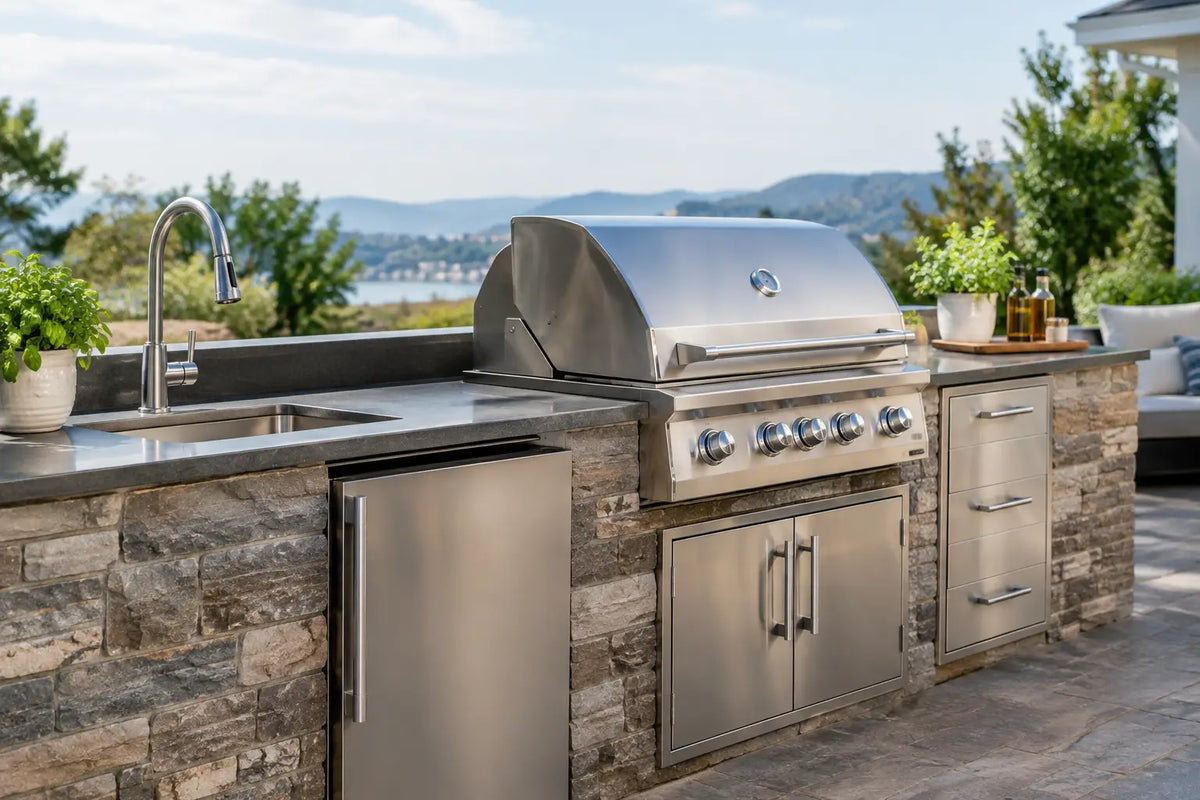
A beautiful outdoor kitchen can look exceptional on delivery day and disappointing after its first hard winter. That is why a proper kitchen durability review should go far beyond surface color, appliance count, and showroom appeal. For a premium terrace, backyard, rooftop, or hospitality setting, durability is the standard that protects the entire investment.
Outdoor kitchens face a more demanding reality than indoor cabinetry. Sun, rain, frost, airborne salt, grease, temperature swings, and daily use all test the materials and construction. The right system should not merely survive those conditions. It should retain its architectural presence, work reliably, and remain easy to own year after year.
Kitchen Durability Review: Start With the Structure
The most important durability decision is usually the one buyers cannot see once the kitchen is installed: the structure behind the fronts, countertop, and appliances. A premium outdoor kitchen needs a stable, corrosion-resistant framework that can carry the weight of grills, stone worktops, refrigeration, and everyday entertaining without shifting or degrading.
Traditional site-built kitchens can be impressive, but their longevity depends heavily on local conditions and contractor execution. If the frame, cladding, drainage, electrical work, and appliance clearances are not coordinated precisely, small weaknesses can become expensive problems. Moisture can enter behind panels, doors can fall out of alignment, and incompatible materials can expand at different rates.
Pre-assembled modular systems reduce that uncertainty. When the cabinet structure, appliance openings, ventilation, and finishes are engineered as one product, there are fewer decisions left to chance on site. This matters particularly for elevated terraces, coastal homes, vacation properties, and commercial environments where reliability must be designed in from the beginning.
Look for a construction approach that feels substantial, not simply heavy. Weight alone does not prove quality. The real indicators are rigid framing, accurately finished edges, secure fixings, properly supported worktops, and doors and drawers that stay aligned through seasonal movement.
Material Performance Is Not a Single Question
There is no universally perfect outdoor-kitchen material. The strongest choice depends on climate, exposure, maintenance expectations, and the visual language of the property. The key is selecting materials for the actual environment rather than for a catalog image.
Stainless Steel: Proven, but Grade Matters
Stainless steel remains a leading choice for outdoor kitchen frames, hardware, and appliance surrounds because it is hygienic, strong, and naturally resistant to corrosion. Yet not all stainless steel performs the same way. Lower-grade steel may be suitable in sheltered locations, while higher-grade marine-oriented steel is the more confident option near the coast or around pools where salt and chlorine can accelerate corrosion.
Even high-quality stainless steel needs occasional care. Grease, mineral deposits, and salt residue should not be left to sit on the surface. A simple routine of gentle cleaning and drying preserves its finish and prevents staining that owners may mistake for permanent damage.
Powder-Coated Metal: Architectural Color With Discipline
Powder-coated aluminum or steel can deliver the clean, tailored appearance that design-led outdoor spaces demand. It also opens up a broader color palette than bare stainless steel. The finish, however, is only as durable as the preparation beneath it and the quality of the coating process.
A premium powder-coated surface should resist UV fading, cracking, and chipping under normal use. It should also be paired with careful edge finishing and intelligent drainage. When water is allowed to collect at joints, even a beautiful finish is being asked to do too much. For exposed locations, examine how panels meet, how water escapes, and whether the base of the kitchen is protected from standing moisture.
Countertops: Heat Resistance Meets Real-Life Care
A countertop has to handle more than serving platters. Outdoors, it may face direct sun, sudden rain, hot cookware, acidic food, and repeated cleaning. Sintered stone, porcelain, granite, and selected engineered surfaces can all perform well, but each has different strengths.
Sintered surfaces and porcelain are often favored for their UV stability, low porosity, and resistance to staining. Natural stone brings depth and character, but it may require sealing and more attentive maintenance depending on its type. The practical question is not whether a material can look luxurious. It is whether it will continue to look composed after a season of real entertaining.
Weather Resistance Requires More Than Waterproof Claims
An outdoor kitchen does not need to be sealed like a submarine. In fact, controlled ventilation and drainage are often essential. What it needs is a design that manages water intelligently and prevents moisture from becoming trapped inside cabinets, beneath countertops, or around appliances.
Check where rainwater goes when it lands on the worktop, doors, and rear of the unit. Assess whether the cabinets sit directly on a wet surface or are raised and protected. Consider the back of the kitchen as carefully as the front, especially when it is freestanding or positioned away from a wall.
Freeze-thaw cycles deserve special attention in colder American climates. Water that enters a vulnerable joint can expand when frozen, stressing finishes, grout, stone, and fixings. A kitchen intended for year-round use should be specified with local weather exposure in mind, not simply shipped into it.
Sun exposure creates a different challenge. Strong UV can fade lesser finishes, weaken plastics, and make dark countertops uncomfortably hot. If a kitchen will face long afternoon sun, material selection, shade planning, and the placement of refrigeration or sensitive appliances should all be part of the design conversation.
Appliances Are a Durability System, Not an Add-On
A grill may be the visual centerpiece, but it cannot compensate for poor integration. The surrounding cabinet must provide the correct cutout dimensions, heat clearance, airflow, and access for service. This is where generic cabinetry often reveals its limits.
Built-in grill compatibility should be confirmed before ordering, especially when selecting respected brands such as Napoleon, Broil King, or Big Green Egg. The appliance, countertop, frame, and ventilation strategy must work together. An improperly vented grill enclosure can create heat damage, safety concerns, and a shortened lifespan for adjacent materials.
The same principle applies to outdoor refrigerators, ice makers, sinks, and storage. Refrigeration needs adequate airflow to operate efficiently. Plumbing requires winterization where temperatures drop below freezing. Gas lines, electrical connections, and drainage should be planned for access, not buried behind a finished facade that makes routine service disruptive.
The Details That Separate Long-Term Quality
In a durability review, small components are rarely small issues. Hinges, drawer runners, handles, leveling feet, seals, and fasteners experience constant movement and exposure. A drawer that glides perfectly in a showroom should still close cleanly after humid summers, cold winters, and hundreds of gatherings.
Pay close attention to door and drawer alignment, especially on long modular runs. Look for soft-close hardware designed for outdoor use and durable handles that will not become loose or uncomfortable in changing temperatures. Cabinet interiors matter too. Easy-to-clean internal surfaces and sensible storage layouts encourage owners to use the kitchen properly rather than overload it or leave equipment exposed.
Installation is another overlooked factor. Even the finest kitchen can underperform on an uneven base or where utility connections are improvised. A level, stable foundation and professionally planned utilities protect the kitchen from strain from day one. Pre-assembled, plug-and-play modules can make this process markedly faster and cleaner, but the site still deserves proper preparation.
How Much Maintenance Should a Luxury Kitchen Need?
The honest answer is: some. No outdoor material is entirely maintenance-free, particularly in harsh climates. But a premium kitchen should make maintenance simple, predictable, and proportionate to its value.
Regular care usually means wiping down surfaces after cooking, removing grease from grills, cleaning stainless steel with suitable products, and checking drainage areas for debris. Seasonal checks should include appliance connections, hinges, countertop joints, and protective covers. In areas with freezing temperatures, plumbing and water-bearing appliances need the correct shutdown routine.
Avoid buying a kitchen that demands constant specialist attention just to remain presentable. The best systems combine high-performance materials with details that are easy to reach, easy to clean, and easy to service. That is luxury with practical intelligence.
A Better Standard for Outdoor Kitchen Longevity
The best outdoor kitchen is not the one with the most dramatic first impression. It is the one that still feels precise, polished, and effortless when friends arrive years later. That standard calls for engineering as refined as the design.
ELEEXA approaches outdoor durability as a complete system: architectural modules, weather-conscious materials, precise appliance integration, and pre-assembled quality that removes unnecessary installation risk. For homeowners and hospitality buyers, that means less time managing a project and more confidence in what remains after the weather has had its say.
Before committing, ask to see the material specifications, appliance integration details, care requirements, and structural approach. A kitchen built to endure does more than extend your living space. It gives every gathering a setting worthy of the investment.